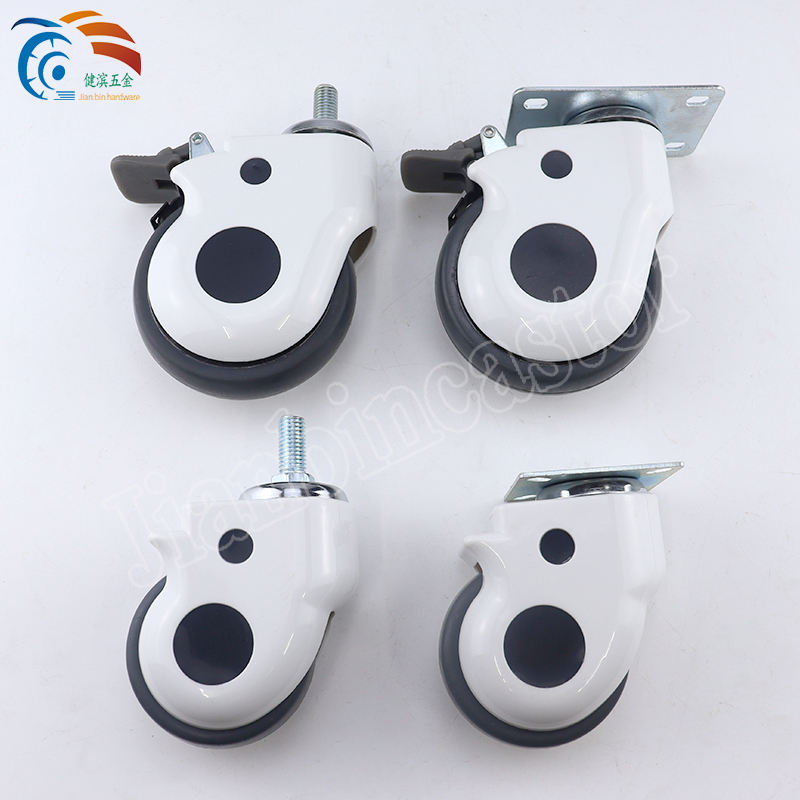
Industrial mobility seems simple at first glance, yet countless manufacturing, warehousing, and logistics facilities face persistent, costly troubles that ordinary casters cannot resolve. Uneven ground wear, sudden load failures, noisy operation, frequent replacement cycles, and safety hazards during heavy transportation all quietly reduce overall production efficiency and increase unexpected maintenance costs. Most buyers only focus on load capacity and unit price when selecting wheels, ignoring core structural quality, ground adaptability, and long-term service stability. Choosing unqualified industrial wheels directly leads to equipment downtime, floor damage, labor waste, and potential safety accidents. High-performance heavy duty industrial casters eliminate these hidden troubles systematically, providing stable, durable, and safe moving support for all types of heavy industrial equipment.
Long-term on-site operation data shows that low-standard casters degrade rapidly under continuous high-load operation. Rubber surfaces crack, wheel shafts loosen, brackets deform, and braking systems lose effectiveness after short periods of use. These invisible problems gradually expand, turning minor faults into large-scale production interruptions. Professional industrial caster manufacturers optimize material formulas, bearing structures, and welding processes according to actual workshop environments, avoiding premature aging and structural damage. Jianbin Caster specializes in customized heavy-load wheel solutions that match diverse industrial scenarios, strictly controlling every production detail to meet harsh working condition requirements.
Many enterprises misunderstand caster selection standards and blindly pursue low prices. They overlook differences in wheel material, bearing precision, bracket thickness, and anti-impact performance. Soft wheels wear fast on rough concrete floors, hard wheels scratch ground surfaces severely, and ordinary bearings cannot withstand frequent high-pressure rotation. Different workshop temperatures, humidity levels, oil contamination, and dust environments also greatly affect caster service life. Proper matching of caster specifications directly cuts daily maintenance frequency and extends overall service life of handling carts, machinery racks, and movable equipment.
Floor protection is another easily neglected deep demand in industrial caster application. Rough, low-quality wheels cause deep scratches, grooves, and wear marks on epoxy floors, cement floors, and polished ground surfaces. Repairing damaged industrial floors requires high costs and temporary production suspension. Premium heavy industrial casters adopt low-abrasion, silent protective wheel materials that reduce friction damage while maintaining strong load-bearing performance. They protect workshop ground integrity without sacrificing flexible moving performance.
Safety risks hidden in caster operation threaten personnel and equipment safety all year round. Unstable steering, ineffective locking, wheel slipping, and sudden breakage during heavy transportation can cause equipment tipping, cargo falling, and worker injuries. Qualified industrial heavy casters adopt double-bearing precision structures, reliable brake locking designs, and anti-offset steering structures. They remain stable even when moving ultra-heavy objects, climbing small slopes, or turning sharply, fully complying with industrial safety operation specifications and reducing accident risks to the lowest level.
Common Industrial Caster Problems & Corresponding High-Quality Solutions
| Pain Point Phenomenon | Root Cause | Effective Solution By Premium Heavy-Duty Casters | Service Life Improvement |
|---|---|---|---|
| Fast wheel wear & frequent replacement | Low-density raw materials, poor wear resistance formula | High-strength polyurethane integrated wheel material | 3–5 times longer service cycle |
| Loud noise during movement | Rough bearing clearance, unbalanced wheel rotation | Precision sealed silent double ball bearings | Noise reduced by over 70% |
| Bracket deformation under heavy load | Thin steel plate, weak welding process | Thickened stamped steel bracket, reinforced integral welding | No permanent deformation under rated overload |
| Poor adaptability to uneven ground | Single wheel structure, weak shock absorption | Arc-shaped wheel surface + flexible steering structure | Stable movement on bumpy and rough floors |
| Failed braking & safety hazards | Simple single brake structure | Double-lock positive braking system | Reliable positioning without sliding displacement |
In actual warehouse and factory scenarios, continuous 24-hour operation tests the comprehensive performance of industrial casters far beyond static load parameters. Static load data advertised by ordinary products cannot reflect real working conditions. Long-time rolling, frequent turns, repeated loading and unloading, and mixed dust-oil environments accelerate component aging. Professional heavy-duty casters pass multiple dynamic load tests, high-temperature resistance tests, corrosion resistance tests, and wear resistance tests before leaving the factory, adapting to continuous uninterrupted industrial production schedules.
Workplace efficiency improvement also relies heavily on flexible caster mobility. Stiff steering increases physical labor intensity of operators, slows down cargo handling speed, and prolongs overall logistics turnover time. Optimized steering structures reduce rotation resistance significantly, allowing one-person easy pushing of dozens of tons of heavy equipment. Smooth steering cooperates with flexible direction adjustment, greatly improving daily handling efficiency and reducing worker fatigue.
Oil resistance, corrosion resistance, and low-temperature resistance are essential performance indicators for special industrial environments. Chemical workshops, cold storage warehouses, outdoor open-air yards, and oil-stained production lines all require customized caster performance. Ordinary wheels soften and deform in oily environments, crack in low temperatures, and corrode rapidly in corrosive conditions. Special formula heavy casters maintain stable physical properties in extreme environments, avoiding performance attenuation and unexpected failures.
Overall cost control for enterprises does not depend on initial purchase price alone. Low-cost cheap casters require frequent purchasing, installation, and downtime maintenance, accumulating huge invisible expenses year after year. Durable heavy industrial casters reduce replacement frequency, lower maintenance labor costs, avoid production pause losses, and bring obvious long-term economic benefits. From full-life cycle cost analysis, high-quality industrial casters are far more cost-effective than inexpensive inferior products.
To sum up, industrial caster selection is not a simple hardware matching issue, but a systematic plan related to production safety, site maintenance, operation efficiency, and enterprise comprehensive cost. Focusing only on surface parameters cannot solve deep hidden problems in actual use. Choosing standardized, professionally manufactured heavy-duty industrial casters fundamentally solves mobility bottlenecks in industrial production, creates stable long-term operation conditions, and supports sustainable and efficient operation of factory logistics and equipment movement.